Support our educational content for free when you purchase through links on our site. Learn more
Are Giant Mountain Bikes Pro-Ready? 🚵


Yes—Giant mountain bikes can be suitable for professional riders, provided the model, build, fit, and suspension setup match the discipline. The Anthem targets cross-country racing, the Reign is built for enduro, and the Glory is Giant’s downhill platform; one model can’t do every job equally well.
The name on the frame is only the starting point. We’ve seen riders chase lighter parts before sorting out tire choice or cockpit fit, then wonder why their bike feels twitchy on descents. For competition, a well-matched setup usually matters more than a flashy upgrade.
Key Takeaways
- Giant makes mountain bikes for serious competition, from XC to downhill, but choose the right model for your event.
- Compare exact model-year components and geometry. Specs can vary by trim and region.
- Fit and setup matter: suspension tuning, tires, brakes, and frame size all affect race performance.
- A recreational or entry-level Giant isn’t automatically a pro race bike. Check whether its components can handle your course.
- Confirm local service support and race rules, especially for electric mountain bikes.
Table of Contents
- ⚡️ Quick Tips and Facts
- 🚵 Giant Mountain Bikes and Professional Riding: The Short Answer
- 🏁 How Giant Became a Force in Mountain Biking
- 🧭 What Makes a Mountain Bike “Professional-Grade”?
- Race-ready frame design and geometry
- Suspension performance and adjustability
- Components, brakes, wheels, and tires
- 🔍 Are Giant Mountain Bikes Suitable for Pro Riders? 8 Key Factors
- 1. Frame quality and carbon technology
- 2. Climbing efficiency and pedaling feel
- 3. Descending control and suspension tuning
- 4. Weight, stiffness, and durability
- 5. Component performance and upgrade options
- 6. Fit, sizing, and rider-specific setup
- 7. Race support, service, and spare parts
- 8. Value versus boutique and other race brands
- 🚲 Giant Mountain Bike Range: Which Models Suit Competitive Riders?
- Anthem: cross-country racing and marathon events
- Trance: trail racing and all-day mountain rides
- Reign: enduro racing and aggressive descents
- Glory: downhill racing and bike-park laps
- Stance and Talon: capable platforms with upgrade considerations
- 📊 Giant Mountain Bike Models Compared
- 🥇 Which Giant Bike Is Best for Each Type of Pro Rider?
- Cross-country and marathon racers
- Trail and enduro competitors
- Downhill racers
- Professional riders on a budget
- ⚙️ Stock Build or Custom Race Setup?
- Suspension setup, sag, and rebound
- Tires, tire pressure, and tubeless systems
- Gearing, brakes, cockpit, and contact points
- ✅ Advantages and ❌ Drawbacks of Racing a Giant Mountain Bike
- 🆚 Giant Compared with Specialized, Trek, and Canyon
- 🛠️ Maintenance, Reliability, and Race-Day Preparation
- 🛒 How to Choose the Right Giant Mountain Bike for Competition
- Match the bike to your discipline and terrain
- Choose the right frame size and suspension travel
- Check race rules, warranty, and component compatibility
- ❓ Frequently Asked Questions About Giant Bikes for Professional Riders
- Do professional mountain bikers race Giant bikes?
- Are Giant bikes good enough for elite-level competition?
- Is a Giant carbon mountain bike worth choosing for racing?
- Can an entry-level Giant become race-ready?
- How long do Giant mountain bikes last under hard use?
- 🏁 Conclusion
- 🔗 Recommended Links
- 📚 Reference Links
⚡️ Quick Tips and Facts
Yes, Giant makes mountain bikes suitable for professional-level competition. The crucial question isn’t whether the name on the downtube is “pro enough.” It’s whether the specific model, build, fit, suspension setup, and support suit your event and riding style.
If you’re comparing manufacturers, our guide to what bike brand has a mountain in the name? is a useful detour. For the quick answer, though, keep these points in mind:
| Quick fact | What it means for a competitive rider |
|---|---|
| Giant offers bikes across XC, trail, enduro, downhill, and eMTB categories | Choose by discipline; a capable trail bike isn’t automatically an XC race bike or downhill rig. |
| Model names and specifications change by year and market | Check the current Giant mountain-bike range and the exact model-year build. |
| Higher-tier builds generally bring lighter frames and stronger race-focused components | Compare the full parts list, not just the frame material or model name. |
| Suspension setup can be as important as suspension travel | Set sag, rebound, compression, and tire pressure for your weight and terrain. |
| A good fit can outweigh a fancy component upgrade | Frame size, reach, stack, and droper-post clearance need to work for your body. |
| Not every Giant is a professional race bike | Entry-level hardtails and value eMTBs can be great for recreation without being ideal for elite racing. |
Our shop-floor shorthand: choose the right Giant, not simply the most expensive Giant. A well-fitted Anthem can make sense for XC; a Reign fits aggressive enduro better. Meanwhile, an e-bike like the Stance E+ may be excellent for powered trail riding but isn’t a substitute for a conventional race bike in events that prohibit motor assistance.
For more manufacturer and model comparisons, browse our Bike Brand Guides and Bike Reviews. 🚵
🚵 Giant Mountain Bikes and Professional Riding: The Short Answer
Giant mountain bikes can absolutely be suitable for professional riders—but suitability depends on the discipline, build, and setup. Giant is a major bicycle manufacturer with dedicated mountain-bike platforms, from short-travel cross-country machines to long-travel downhill bikes. Its official range is the best starting point for confirming what’s currently available in your region: Giant mountain bikes.
The name on the frame doesn’t guarantee that a particular bike is competition-ready. A pro racing the Anthem in an XC event has different needs from an enduro racer aboard a Reign, or a downhill athlete on a Glory.
The short version by riding goal
- XC racing: Look at a race-oriented, short-travel platform such as the Anthem. Prioritize efficient pedaling, low weight, precise fit, and a suitable tire setup.
- Trail and enduro: Compare the Trance and Reign families according to course severity and how much climbing you must pedal.
- Downhill: A dedicated downhill platform such as the Glory is more relevant than adapting a trail bike beyond its intended use.
- Recreational riding or training: A less race-focused model may be completely appropriate, especially if you value comfort, durability, and versatility over minimum weight.
- eMTB racing or powered trail use: Confirm the event’s rules before choosing an electric model. Motor assistance changes which competitions you can enter.
A useful distinction comes from a review of the Giant Stance E+ 1 Pro. The testers praised its trail handling and motor system but considered its fork and weight less suited to “advanced and aggressive riding” than higher-end options. That’s a review of one specific eMTB build—not evidence that every Giant has the same limits. See the MBAction review and Giant’s current electric mountain-bike range.
Likewise, the Giant Revolt X Advanced Pro 0 review addresses a gravel bike, not a mountain bike. Its drop bars and gravel-oriented design make it a poor stand-in for a purpose-built technical mountain bike. The reviewer’s warning that it was “unsuited to anything resembling real mountain biking” is a useful reminder: judge the bike by its category and intended terrain, not by a few millimeters of suspension or adventurous marketing.
So which Giant model actually matches a professional rider’s demands? First, we need to define “professional-grade”—because speed is only one part of the job.
🏁 How Giant Became a Force in Mountain Biking
Giant is a Taiwanese bicycle manufacturer that has grown into one of the world’s largest bicycle brands. Its own company history describes its development from a manufacturing operation into a global bicycle brand. That manufacturing scale matters to buyers because it can support a broad model lineup, parts availability, and a wide dealer network—though your local service experience still depends on the retailer and region.
Giant’s mountain-bike lineup includes platforms aimed at distinct jobs:
- Anthem: cross-country and marathon-style riding.
- Trance: trail riding and varied terrain.
- Reign: enduro and aggressive gravity-oriented trails.
- Glory: downhill riding and racing.
- Talon: hardtail trail use and entry-level competition, depending on build and event.
- Stance E+: electric trail riding rather than a conventional unassisted race platform.
Giant’s design story also includes technologies such as Maestro suspension on selected full-suspension models and Advanced-grade composite frames on certain builds. Those labels are starting points, not magic spells. A suspension layout still needs appropriate damping and setup; a carbon frame still needs careful inspection and a geometry that fits you.
The practical takeaway: Giant’s history and production scale support its credibility, but model-by-model performance is what matters on race day. We’d never recommend buying a frame badge without checking the exact build sheet, geometry, and suspension platform.
🧭 What Makes a Mountain Bike “Professional-Grade”?
“Professional-grade” is not a universal checklist stamped on every frame. A bike can be suitable for a professional rider without being the brand’s top build, and a flagship model can still be wrong for a rider’s event or body.
For us, a competition-ready mountain bike should meet four basic tests:
- It fits the discipline. An XC course rewards efficiency and climbing; downhill rewards control and impact management.
- It fits the rider. Frame size, geometry, suspension tune, and cockpit must work together.
- Its components can handle the workload. Brakes, wheels, tires, drivetrain, and suspension must suit the terrain and rider.
- It can be maintained reliably. Race weekends are a bad time to discover a proprietary part is unavailable locally.
The International Cycling Union publishes technical and competition rules, including equipment requirements for sanctioned events. Check the relevant UCI regulations and your event’s supplementary rules rather than assuming a setup is legal.
Race-ready frame design and geometry
Geometry shapes how a bike climbs, corners, and behaves when the trail gets steep. Key measurements include:
| Geometry term | Why it matters |
|---|---|
| Reach | Affects standing room and how stretched or compact the cockpit feels. |
| Stack | Influences handlebar height and front-end position. |
| Head-tube angle | Helps describe steering feel and stability, especially on descents. |
| Seat-tube angle | Affects seated climbing position and weight distribution. |
| Chainstay length | Influences rear-wheel behavior, climbing traction, and cornering feel. |
| Wheelbase | Contributes to stability and maneuverability. |
Numbers alone don’t tell the whole story. A longer reach can feel stable at speed but may be too stretched for your torso or arm length. A steper seat angle can help with seated climbing, but it does not rescue a poor fit.
We’ve seen tall riders arrive at the trailhead convinced they need the biggest frame available, then discover that stack height, handlebar rise, and droper clearance matter just as much as frame size. The tall-rider video linked at #featured-video highlights how riders adjust reach, bar height, chainstay length, brake-rotor size, and droper travel to suit their bodies and local trails. Its examples are individual setups—not universal prescriptions—but the lesson is sound: fit is a system, not a size label.
Suspension performance and adjustability
A competitive suspension setup should offer suitable travel and damping for the event. More travel is not automatically better: extra travel can add weight and alter pedaling feel, while too little travel can leave the bike overwhelmed on rough courses.
Look at:
- Spring type: air or coil, depending on the bike and intended use.
- Compression damping: how the suspension resists compressing under forces such as braking or pedaling.
- Rebound damping: how quickly it extends after compression.
- Adjustability: useful only if the rider can tune it effectively.
- Serviceability: suspension needs regular maintenance; check the maker’s service recommendations.
For a basic setup, use the suspension maker’s guidance and record your settings before changing them. FOX’s tuning resources and RockShox TrailHead offer product-specific setup information. A suspension specialist can help if you’re racing at a high level or repeatedly using all the travel without understanding why.
Components, brakes, wheels, and tires
The frame may get the attention, but component choices can make or break a race.
- Brakes: Match rotor size and brake power to rider mass, descent length, and conditions.
- Wheels: Durability and serviceability can matter more than a few grams.
- Tires: Casing, tread, and compound need to match the course. Fast-rolling tires are not automatically fast if they puncture or lose grip.
- Drivetrain: Check gear range, shifting under load, and replacement-part compatibility.
- Contact points: Saddle, grips, pedals, and handlebar width influence comfort and control.
A race-focused build should be reliable before it is exotic. We’d rather see a rider start with fresh brake pads and a proven tire setup than spend a weekend chasing a tiny weight saving while the rear brake sings like a kettle.
🔍 Are Giant Mountain Bikes Suitable for Pro Riders? 8 Key Factors
Here’s our practical scorecard for evaluating a Giant mountain bike for competitive riding. These are category-level assessments, not test-lab ratings of every current model. Actual performance varies by year, trim, size, setup, and course.
| Factor | General assessment | What to verify |
|---|---|---|
| Frame and design | 8/10 | Frame material, geometry, intended discipline |
| Functionality | 8/10 | Suspension platform and fit for the event |
| Component potential | 8/10 | Exact drivetrain, brakes, wheels, and tires |
| Race versatility | 7/10 | Whether the model is specialized or multipurpose |
| Service practicality | 8/10 | Dealer support and replacement-part availability |
| Competitive suitability | 8/10 | Strong when the model and build match the discipline |
1. Frame quality and carbon technology
Giant sells both aluminum and carbon mountain bikes, with carbon used on selected higher-tier models. The brand’s frame technology information explains its materials and construction terminology. For racing, carbon can offer a favorable stiffness-to-weight balance, while aluminum can be a sensible choice for riders prioritizing durability, repair practicality, or a lower-cost frame platform.
Neither material guarantees speed. Fit, geometry, wheels, tires, and rider ability still matter. Carbon should also be inspected after a significant impact; don’t dismiss cracks, unusual creaking, or damage around high-stress areas.
2. Climbing efficiency and pedaling feel
XC riders and stage racers often spend long periods climbing, so efficient pedaling and a suitable gear range matter. Giant’s short-travel options, including the Anthem family, are more relevant to that job than a long-travel downhill bike.
On a full-suspension model, test the bike climbing seated and standing. Pay attention to:
- How the rear suspension responds to smooth pedaling.
- Whether the front wheel wanders on steep climbs.
- Whether the gearing gives you a usable low gear.
- How the bike behaves with the suspension settings you’ll actually race.
A lockout can help on smooth climbs or fire roads, but it’s not a substitute for a well-matched suspension design. The bike should remain composed when the course gets rough.
3. Descending control and suspension tuning
Enduro and downhill riders need predictable suspension, strong brakes, secure tires, and geometry suited to steep terrain. A trail bike may descend impressively, but that doesn’t make it the best option for a full-on downhill race.
A useful caution comes from the MBAction Stance E+ 1 Pro review. The review found the eMTB’s rear suspension capable and its handling appealing, but described the fork as a limitation for faster, aggressive riding. That assessment concerns the tested Stance E+ build; it should not be generalized to Giant’s higher-tier Reign or Glory models.
The lesson is straightforward: evaluate the exact fork and shock, not just the travel number. A well-damped 150 mm fork can inspire more confidence than a poorly controlled fork with more travel.
4. Weight, stiffness, and durability
Weight matters, especially in XC, but it isn’t the only performance metric. A lighter bike may accelerate quickly yet be less suitable for a rough course if the wheels, tires, or frame setup are too fragile for the rider’s demands.
Stiffness is also a balance. Too much flex can feel imprecise under hard cornering; too much rigidity can make a bike harsh and tiring. We recommend judging the whole ride: does it track straight, hold a line, and stay comfortable enough for repeated laps?
For eMTBs, the battery and motor add substantial mass. The Stance E+ review reported a test-bike weight of 56.6 lb without pedals for its reviewed build, a figure that illustrates why a capable electric trail bike is not the same tool as a lightweight conventional race bike. Always check the model year and spec before comparing weights.
5. Component performance and upgrade options
A complete build can be race-ready straight from the shop—or need targeted changes. Check:
- Brake model and rotor size.
- Fork and shock model, not just travel.
- Wheel construction and hub serviceability.
- Tire casing and tread.
- Droper-post travel and insertion depth.
- Drivetrain range and replacement-part availability.
Prioritize upgrades in this order: fit and safety, tires and brakes, suspension setup, then weight or boutique parts. If the stock wheels are dependable and the tires suit your course, don’t replace them just because a race photo features shiny carbon rims.
6. Fit, sizing, and rider-specific setup
Giant’s size charts are a useful starting point, but riders with long legs, short torsos, broad shoulders, or unusual proportions may need more careful fitting. Compare the manufacturer’s geometry charts with your current bike and, when possible, test ride multiple sizes.
The tall-rider setup examples in the video at #featured-video show athletes using changes such as higher-rise bars, longer reach, larger rotors, and long-travel droppers. For one rider, a 240 mm droper is useful; for another, the post may not fit inside the frame. Do not copy an athlete’s setup without checking frame compatibility and your own fit.
7. Race support, service, and spare parts
A pro bike is only useful if it can be serviced before the next start. Before committing to a platform, ask your local Giant dealer:
- Can they service the suspension and frame bearings promptly?
- Are the hanger, axle, and proprietary parts available?
- Does the bike use standard parts for brakes, drivetrain, and cockpit?
- What maintenance intervals apply to the fork, shock, and droper?
- Is there a nearby dealer or race-day support arrangement?
Check Giant’s official support and manuals for model-specific documents. Availability varies by country, so don’t assume your friend’s excellent parts access applies to your region.
8. Value versus boutique and other race brands
Giant’s broad product range gives riders a choice of builds and materials across several disciplines. Whether a Giant is better value than a competitor depends on the exact model-year specification, warranty, dealer support, and discounts available locally—not a blanket “cheap brand” label.
The Quora discussion about whether Giant is a cheaper brand is worth treating cautiously: the page is not a verifiable product test and does not provide reliable evidence about a specific model’s race performance. Use manufacturer specs, independent reviews, and hands-on testing to settle that question.
🚲 Giant Mountain Bike Range: Which Models Suit Competitive Riders?
Giant model names and specifications can vary across countries and model years. The list below describes general platform roles, not a guarantee that every trim is sold everywhere. Confirm the current model details on Giant’s official pages before choosing.
Anthem: cross-country racing and marathon events
The Anthem is the Giant family to investigate first for XC competition. Its short-travel, race-oriented brief makes it more appropriate for speed-focused courses than a long-travel enduro machine.
Good fit for:
- Cross-country racing.
- Marathon events and fast, rolling singletrack.
- Riders who value climbing and acceleration.
Check before buying: the exact travel and suspension configuration, tire clearance, component build, and whether the geometry suits your course. For technical courses, the fastest setup may still need more protective tires or a more supportive suspension tune.
Trance: trail racing and all-day mountain rides
The Trance family sits in the versatile trail category. Depending on the specific version, it can make sense for riders who want one bike for training, technical trails, and less specialized competition.
Good fit for:
- Trail events and mixed-terain riding.
- Riders who want a capable climber and confident descender.
- Racers whose courses don’t demand a dedicated downhill bike.
A general-purpose trail bike is a compromise by design. It may be heavier or less efficient than a focused XC bike, and less composed at race pace on extremely rough downhill tracks. Choose it if versatility is part of the brief, not because “one bike must do everything” sounds tidy on a spreadsheet.
Reign: enduro racing and aggressive descents
The Reign is Giant’s enduro-oriented platform. Riders considering it should compare the exact wheel setup, travel, suspension components, brake specification, and geometry for the intended race series.
Good fit for:
- Enduro stages with demanding descents.
- Step, rough trails and aggressive trail riding.
- Riders who need more support and control than a shorter-travel trail bike provides.
The trade-off is the usual one: a bike built to descend confidently can feel like more work on long climbs. Tires, suspension setup, and the rider’s pacing strategy can change that feel considerably.
Glory: downhill racing and bike-park laps
The Glory is the dedicated downhill family to explore for gravity racing. Its purpose is not to be an efficient all-day climbing bike; it is designed around descending demands.
Good fit for:
- Downhill racing.
- Lift-access bike parks.
- Riders who need a dedicated gravity bike.
Check the current version’s suspension components, wheel configuration, adjustability, and parts compatibility. Downhill bikes take heavy abuse, so wheel and brake serviceability deserve a spot on the shopping list.
Stance and Talon: capable platforms with upgrade considerations
The Stance is a trail-oriented full-suspension family, while the Talon is a hardtail line. Both can be enjoyable, practical bikes; whether a particular build suits competition depends on the course and the parts fitted.
Potential strengths:
- A sensible platform for learning, training, and recreational riding.
- Hardtails can be effective on smoother XC courses.
- A simpler build may be easier to maintain.
Possible limitations:
- Lower-tier forks, brakes, wheels, or drivetrains may be outmatched by demanding race use.
- Upgrading many components can cost more time and effort than choosing a better-equipped model initially.
- A recreational eMTB is not a conventional race bike, and some events prohibit motor assistance.
For model-specific reviews beyond Giant, visit Bike Reviews. ⚙️
📊 Giant Mountain Bike Models Compared
This comparison is a platform guide, not a substitute for checking the precise year and trim. Giant updates models and specifications, and regional versions may differ.
| Giant family | General category | Typical competitive use | Main strengths to investigate | Watch-outs |
|---|---|---|---|---|
| Anthem | XC full suspension | XC and marathon | Pedaling efficiency, race-oriented design | Course may call for more travel or tougher tires |
| Trance | Trail | Mixed trail events | Versatility and balanced handling | Not as specialized as XC or downhill platforms |
| Reign | Enduro | Enduro and aggressive trails | Descending control and rough-terain capability | More bike to pedal on long climbs |
| Glory | Downhill | Downhill and bike park | Gravity-focused design | Not suited to ordinary trail climbing |
| Talon | Hardtail | Training and selected XC use | Simplicity and direct pedaling feel | Rear-wheel comfort and traction depend heavily on setup |
| Stance E+ | Electric trail bike | eMTB events and recreational riding | Motor assistance and trail versatility | Weight, component limits, and event regulations |
How to read the table
- Category beats model prestige: the wrong category can feel wrong even at the top trim.
- Build beats buzzwords: two bikes in one family may have very different forks, brakes, and wheels.
- Current specifications beat old reviews: use reviews to understand ride character, then verify what is actually sold now.
- Race rules matter: an eMTB may be perfect for an eMTB event and ineligible for a conventional unassisted race.
A note on two often-confused models: the Giant Revolt X Advanced Pro 0, where available, is a gravel bike, not a mountain bike. In the Cyclist review, the reviewer praised its ability on rough non-technical ground while warning that technical mountain-bike terrain was beyond its comfort zone. That is not a contradiction: the bike’s suspension helps on rough gravel, but drop bars and gravel geometry remain different tools from a mountain bike’s flat-bar control.
🥇 Which Giant Bike Is Best for Each Type of Pro Rider?
There isn’t one best Giant for every professional rider. Start with the race format, then consider the course, rider, and support available.
Cross-country and marathon racers
Start with the Anthem family. Focus on a light, efficient build, reliable shifting, tire choice, and a position you can sustain through a long event.
Questions to ask:
- Is the course smooth and fast, or steep and technical?
- Is a hardtail or full suspension more advantageous?
- Can you handle the selected tire casing without frequent punctures?
- Are you comfortable on the frame size over multiple hours?
Trail and enduro competitors
Compare the Trance and Reign around course severity. A Trance-style trail bike may suit an event with moderate descents and substantial pedaling. A Reign-style enduro bike is more relevant when the timed stages are rough and steep.
Test climbing and descending in the same setup you plan to race. A bike that feels plush in a parking-lot bounce test may pedal differently once the shock settings and tire pressures are dialed for real terrain.
Downhill racers
Look at a dedicated downhill platform such as the Glory. Prioritize a stable fit, strong brakes, appropriate suspension spring and damping, and a wheel-and-tire setup that can survive repeated runs.
Downhill racers should also budget time for spares and maintenance. A spare deraileur hanger is useful; a fresh set of pads at the venue is even more comforting than the world’s fanciest paint.
Professional riders on a budget
A lower-trim model can be a practical starting point, but compare its components against the demands of your event. The key question is whether it needs one or two sensible changes or a long list of upgrades.
If you are considering a Stance E+ because it looks like a lot of bike for the job, remember that the MBAction review describes a capable recreational and enthusiast eMTB, while identifying limits for advanced aggressive riding in the tested build. That’s useful context, not a verdict on all Giant bikes.
For riders comparing more everyday categories, see our Electric Bikes and Bike Accessories guides.
⚙️ Stock Build or Custom Race Setup?
A stock bike can be a strong starting point. Don’t replace parts just because a teammate has a different setup. First establish a baseline, then make one change at a time so you know what actually helped.
Suspension setup, sag, and rebound
Use this simple process:
- Check the correct manual. Confirm the exact fork and shock model.
- Set pressure or spring rate for your weight. Follow the suspension maker’s starting recommendations.
- Measure sag in riding kit. Wear your shoes, helmet, pack, and race clothing if they affect your riding load.
- Set rebound conservatively. Too fast can feel bouncy; too slow can leave the suspension packed down through repeated hits.
- Ride a familiar trail. Use a short loop with climbing, braking bumps, and corners.
- Change one setting at a time. Record the change and the result.
- Recheck before racing. Temperature, altitude, and a different course can alter the feel.
Consult FOX’s mountain-bike setup resources or RockShox TrailHead for product-specific guidance. A generic setting copied from a forum is a starting clue, not a personalized tune.
Tires, tire pressure, and tubeless systems
Tire choice is one of the easiest ways to change how a bike behaves. Match the tread and casing to the course:
- Hardpack: faster tread may roll efficiently.
- Loose corners: more supportive side knobs can add confidence.
- Rocky terrain: a tougher casing can reduce puncture risk.
- Wet roots and mud: compound and tread clearance become especially important.
For tubeless systems, check sealant condition, rim-tape integrity, and valve security before an event. Start with pressure that gives adequate grip without rim strikes or tire squirm, then adjust in small increments. There is no magic pressure that suits every tire width, rider weight, rim, and trail.
Gearing, brakes, cockpit, and contact points
Race-day comfort and control come from small details:
- Gearing: verify the low gear is useful on the steepest climb and the high gear works for fast sections.
- Brakes: bed in new pads and rotors before the event; check lever reach and brake feel.
- Cockpit: choose bar width and rise that support your shoulders and terrain.
- Droper post: confirm adequate travel and that it can fully insert into the frame.
- Saddle and grips: test them on training rides, not for the first time at the start line.
Tall riders, in particular, may need a combination of increased reach and stack rather than a simple move to the largest frame. The examples at #featured-video show why a rider-specific approach can make a bike feel calmer and more predictable.
✅ Advantages and ❌ Drawbacks of Racing a Giant Mountain Bike
| ✅ Potential advantages | ❌ Potential drawbacks |
|---|---|
| Broad range of bikes for different mountain-bike disciplines | Some models or trims are more recreational than race-focused |
| Manufacturer information and technical support through Giant’s network | Dealer and parts support depend on your region |
| Options across carbon and aluminum frames | Carbon is not automatically the right choice for every rider or course |
| Multiple platforms for XC, trail, enduro, downhill, and eMTB | The same brand name does not mean the models share the same race capability |
| Opportunity to select a build and tune it to your needs | Lower-tier components may need upgrading for demanding competition |
| A known brand with a large product range | Model-year and regional specifications can be confusing |
Our balanced verdict: Giant is a credible choice for professional riders when the bike is selected for the correct discipline and configured well. The weak choice is not “Giant”; it’s buying a bike intended for a different job, then asking upgrades to turn it into something it was never designed to be.
🆚 Giant Compared with Specialized, Trek, and Canyon
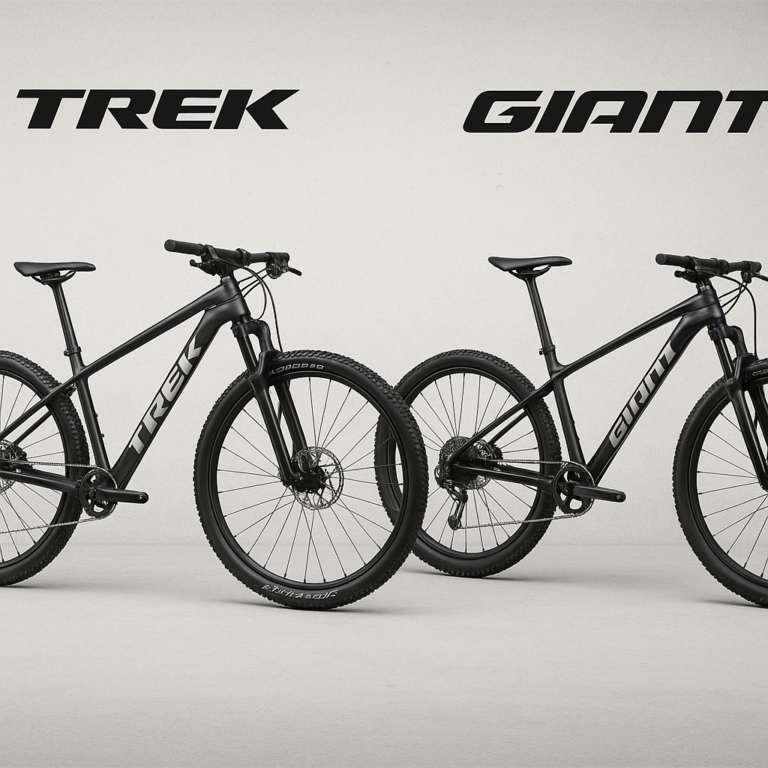
Giant, Specialized, Trek, and Canyon all offer mountain bikes across multiple categories. Comparing logos alone is like comparing helmets by paint color: entertaining, perhaps, but not a useful way to choose.
| Brand | What to compare | Best way to evaluate |
|---|---|---|
| Giant | Model fit, current build, dealer support | Compare platform and exact component specification |
| Specialized | Discipline-specific models and suspension designs | Test the equivalent category and frame size |
| Trek | Geometry, build options, service access | Compare warranty terms and local support |
| Canyon | Direct-sales configuration and service arrangements | Confirm assembly, maintenance, and replacement-part access |
The fairest comparison is same discipline, similar frame material, comparable suspension, and equivalent component level. Also compare total ride readiness: tires, brake rotors, droper travel, and the service network near your home or race venues.
A top-spec Giant may be a better fit than a competitor’s entry build, while a different brand’s geometry may suit your body better. Test rides—and an honest fit assessment—beat online brand arguments every time.
🛠️ Maintenance, Reliability, and Race-Day Preparation
Hard racing increases wear. Make maintenance part of your training schedule, not a frantic ritual beside the start pen.
A practical pre-race check
- Inspect the frame, fork, shock, wheels, and handlebar for visible damage.
- Check tire condition, pressure, sealant, and valve security.
- Confirm brake pad thickness and lever feel.
- Check chain wear, shifting, and deraileur alignment.
- Tighten bolts to the manufacturer’s specified torque.
- Test the droper post through its full travel.
- Carry the correct spare tube, plugs, pump, multi-tool, and chain quick link.
- Record suspension settings so you can restore them after travel or service.
For official documentation, use Giant’s support page and the relevant component maker’s service instructions. Don’t use generic torque guesses on carbon parts; the correct value and assembly method matter.
Our team’s race-week lesson: the first time you discover a slow leak should not be on the start line. Do a shakedown ride after any tire, brake, suspension, or cockpit change. Your future self will be less sweaty.
🛒 How to Choose the Right Giant Mountain Bike for Competition
Work through this checklist before committing:
- Name the event. XC, enduro, downhill, and eMTB racing require different tools.
- Study the course. Note climbing, technical descents, surface, and likely weather.
- Choose the platform. Start with Anthem, Trance, Reign, Glory, or another appropriate Giant family.
- Compare the exact builds. Record fork, shock, brakes, wheels, tires, and droper specifications.
- Check the geometry. Compare reach, stack, seat angle, and wheelbase with a bike you know.
- Test ride if possible. A size chart can’t tell you how a bike will feel in a corner.
- Ask about service and parts. Find out how quickly local support can handle wear or damage.
- Set the bike up before race day. Confirm suspension, tires, brakes, and fit during training.
- Read event rules. Especially important for eMTB models and equipment modifications.
Match the bike to your discipline and terrain
Use the event as your filter:
- Fast XC and marathon: begin with the Anthem family.
- Mixed singletrack and trail events: assess the Trance.
- Step, rough timed stages: consider the Reign.
- Gravity racing: look at the Glory.
- Powered trail riding: compare Giant’s eMTB range, then verify event eligibility.
A gravel bike with a suspension fork is still a gravel bike. The Revolt X review shows that rough-road comfort doesn’t automatically equal technical mountain-bike control.
Choose the right frame size and suspension travel
Use Giant’s current geometry and sizing information as a baseline, then compare fit in person. Consider:
- Reach and stack in your riding posture.
- Standover and seatpost insertion.
- Droper travel and saddle clearance.
- Suspension travel relative to the course.
- Whether the bike remains manageable on long climbs and tight turns.
The biggest frame is not automatically best for a tall rider. As the setups at #featured-video demonstrate, cockpit height, bar rise, and other fit adjustments can be just as relevant as reach.
Check race rules, warranty, and component compatibility
Before modifying a bike, verify:
- The race’s current equipment and e-bike rules.
- Giant’s warranty conditions in your country.
- Whether changing parts affects warranty coverage.
- Compatibility of brakes, rotors, wheels, axles, drivetrain, and droper post.
- Whether your local shop can source and service the parts.
For sanctioned competition, consult the relevant UCI regulations and the event organizer. A setup that is technically possible may still be unsuitable—or ineligible—for your race.